Made-to-measure sliding-door wardrobes in Lucena
Sliding doors glide along a track instead of swinging out into the room, and that one detail completely changes how a tight bedroom works. If you are looking for sliding-door wardrobes in Lucena, here you will find when this system makes sense, how many panels to choose, what happens to the usable depth, how drawers are handled and which fronts the tracks can take, so you can decide with confidence.
Shape your next wardrobe.
Try out the measurements, plan the interior layout and choose your finishes. See your idea take shape and share it with us so we can prepare your quote.
Send us your configuration with your measurements and we'll give you a guide price within 24 hours, free of charge. The measuring visit at your home comes afterwards.
When sliding doors help in a bedroom
The advantage of sliding doors is obvious as soon as the space in front of the wardrobe is tight. A 60 cm hinged door sweeps a semicircle of that radius; if your bed is fifty centimetres from the wardrobe, it is a daily nuisance. With a sliding system the panel moves parallel to the front and the floor stays clear.
They also make life easier in rooms with a door close by or a window that opens inwards. There is no need to work out swing paths or leave areas unusable.
The price of that convenience is access: with two panels you see half of the interior at a time, and with three, a third, because the panels overlap. If you need to see everything at a glance, you may want to consider a different type of opening. For everything else, a made-to-measure sliding wardrobe is a practical, clean-lined choice for any bedroom in a Lucena home.
Number of doors and how much of the interior you can reach
The number of sliding panels on the wardrobe decides which area is available at any moment. With two panels, the open gap is half the width; with three, it drops to a third, but each panel is narrower and lighter; with four, very long fronts can be widened without the panels becoming too heavy.
A panel that is too wide is heavy and needs sturdier fittings; one that is too narrow multiplies the profiles. The usual balance is between 60 and 100 cm.
Think about where you want easy access. If the right-hand side holds your everyday hangers and the left your seasonal boxes, the panel layout should reflect that. A well-planned sliding-door wardrobe matches each panel to an interior module, so that what you use most sits behind the panel you open most.
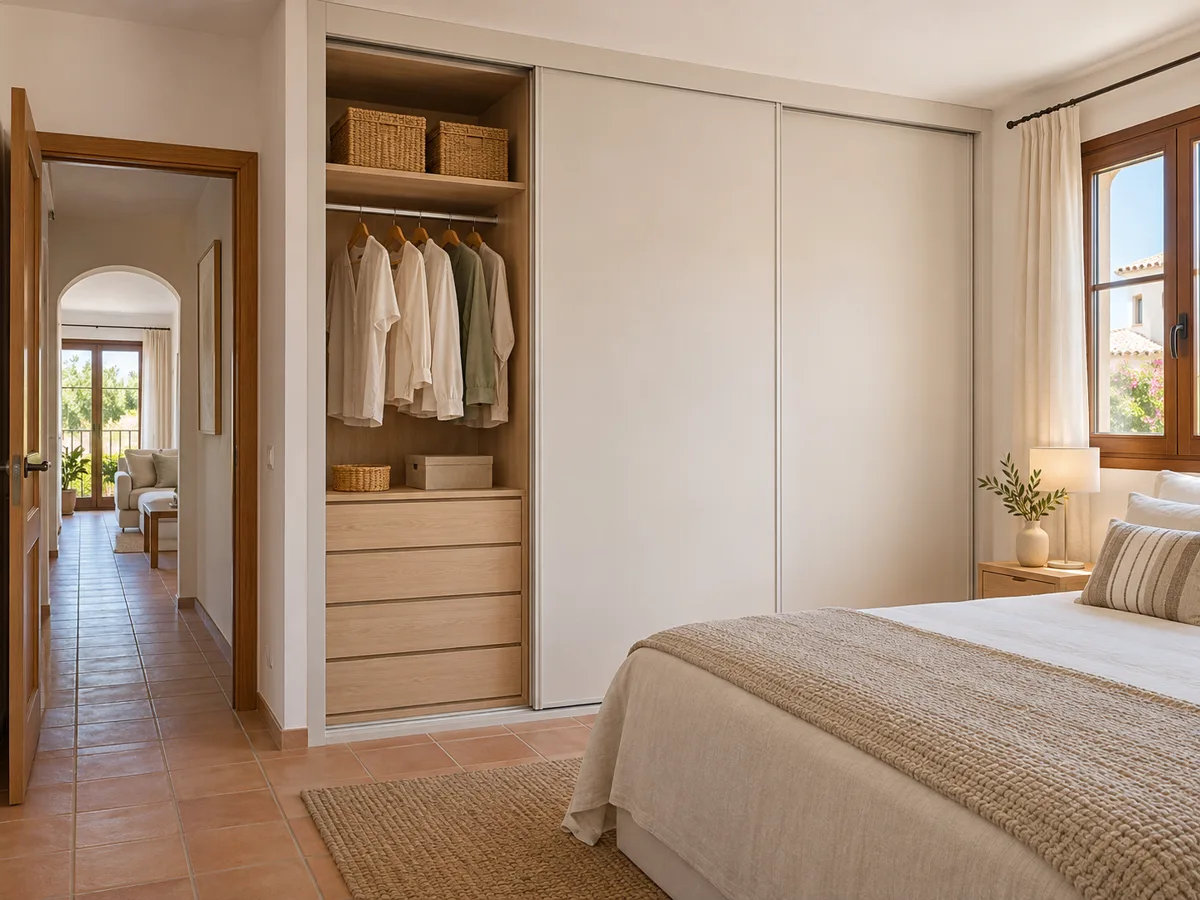
Overall depth and usable storage space
A sliding system needs its own depth for the tracks: the panels run on parallel runners, and that takes a few centimetres compared with a hinged wardrobe. In a narrow bedroom, that loss matters.
Hanging clothes facing forwards takes about 55 cm of interior space. Add the thickness of the tracks and the overlap of the panels, and the total depth comes to around 60 or 65 cm. If your wall cannot spare that much, it can be solved with rotated hanging rails in part of the wardrobe or with a section of shallow shelves and drawers.
Two factors determine the result: the depth you really have available, measured with the plinth and skirting boards, and the thickness of the board chosen. A thin board lightens the whole unit but calls for more reinforcement. That is why it is worth checking both figures before drawing up the final layout.
Have you already measured the space?
Send us a photo and the approximate measurements on WhatsApp and we'll give you some initial guidance.
Drawers and shelves that don't clash with the doors
- 01
It is the most common question about sliding wardrobes: can you open the drawers with the doors closed? It depends on how the interior is designed. If a drawer sits right behind a panel, it can only be opened once that panel has been slid across.
- 02
One solution is to place the drawers in the areas left clear when a panel slides, and another is to size their fronts so they do not coincide with the overlap. You can also use narrower drawers at the ends and keep the centre for hanging rails.
- 03
Deep shelves, for their part, are much appreciated when they are pull-out. A tray that slides forward lets you reach what is at the back without emptying the shelf. To decide on this layout, the configurator lets you try out combinations of modules and see how they line up with the panels. On the interiors and storage page you can see more ideas for the interior.
Runners, profiles and the system's closing action
The heart of sliding doors is the track. The lower one carries the weight or simply guides, and the upper one keeps the panels aligned. The heavier the panel, the more attention the quality of the bearings and runners deserves, because they determine whether the glide is smooth and quiet.
The profiles form the frame of the sliding panels. They can be visible, in aluminium, or practically invisible when the front is board with a slim edge. The aluminium profile gives a more technical look; board with a discreet edge is more understated and blends better into rooms with simple lines.
The closing can be completed with dampers that slow the panel at the end of its travel, or with assisted opening. These are everyday details: they prevent bangs and extend the life of the mechanism. Think about height too, because a floor-to-ceiling panel needs a rigid, well-levelled track.
Latest work by SI, ARMARIO
@si.armario
Made-to-measure wardrobes and walk-in wardrobes
Latest posts
Melamine, mirror and glass doors
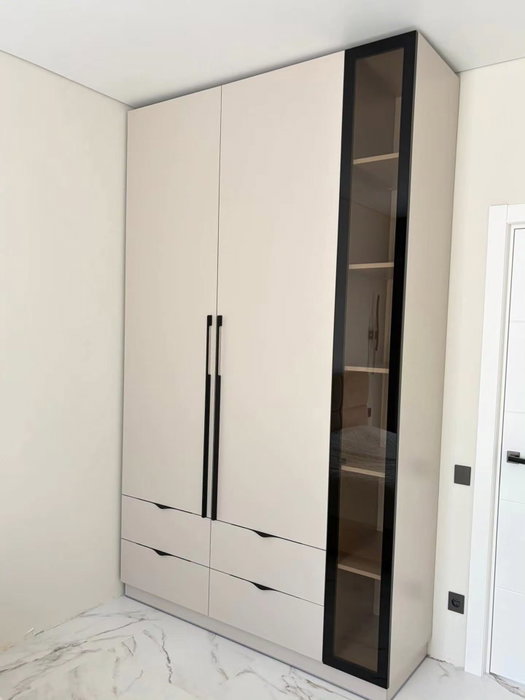
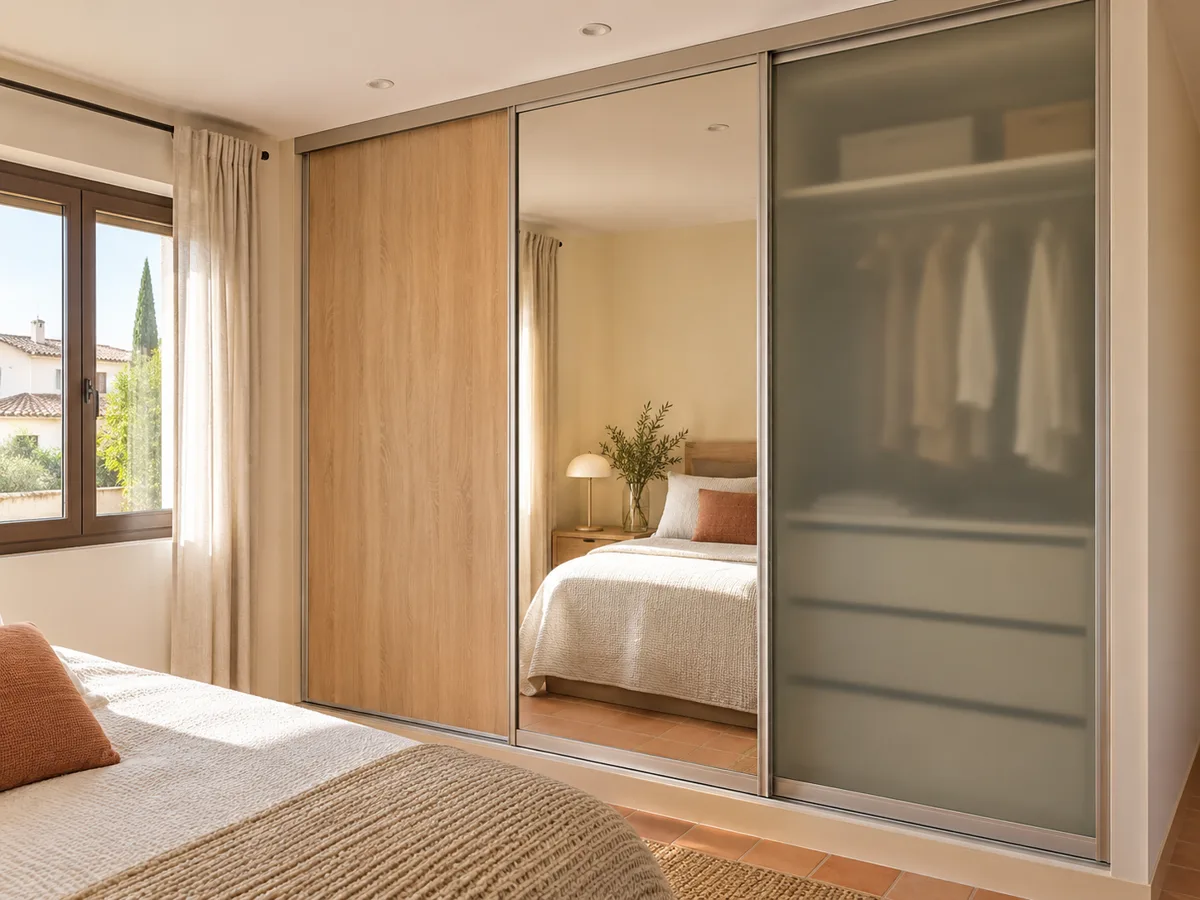
The front is what you see every day, and sliding doors offer several options. Melamine is the most common: it comes in many colours and grains, withstands wear and is easy to clean. A smooth matt front gives a more contemporary look.
A mirror does double duty: it hides the door and bounces light back into the bedroom. A full mirror panel is heavy and reflects everything, so it is best placed facing an area where that won't bother you. You can also combine a mirror panel with a melamine one and alternate textures.
Glass, on the other hand, is a decorative option. It adds shine and colour, and needs slightly more careful upkeep. If you are inclined to mix materials, think about proportion: one mirror panel in a set of three works well, while mirrors throughout can be too much in a small room.
Ask us to come and measure up in Lucena
- 01You leave us your name and your area.
- 02We message you on WhatsApp to agree a day.
- 03The measuring visit costs €50 and is free if you place an order.
What affects the price of the whole unit in Lucena
The price of a sliding-door wardrobe does not depend on width alone. The number of panels, the front material, the type of track, the height and everything fitted inside all count: rails, shelves, drawers and accessories. A full mirror costs more than a melamine front, and a mechanism with soft closing weighs in slightly higher than a basic one.
It also matters whether the unit includes just the doors or the whole carcass with its interior.
The clearest route starts with the configurator: you enter measurements, number of panels and fronts, and the team reviews your design. Once it receives the configuration with the measurements, it will give you a price guide within 24 hours, and the measuring visit that follows costs €50 if the order is not confirmed. Making the pieces takes two to three weeks on average.
Maintenance, and when to choose a different type of opening
- 01
A well-fitted sliding system needs very little. Clean the bottom track from time to time, as dust and fluff build up in it, and wipe the profiles with a cloth. If a panel seems to rub, adjusting the height of the bearings is usually enough.
- 02
There are situations where a different type of opening works better. If the wardrobe goes in a recess between two walls where you want to see the whole interior, hinged doors allow that, and in a very narrow corridor bifold doors can be more convenient. In a built-in alcove, it is worth comparing with a fitted wardrobe, which lets you mix door types.
- 03
If you live in Lucena and are unsure which system to choose, you can send photos of the bedroom and the measurements, and we will assess which suits that wall best.
Enquiry
Tell us about your project in Lucena
- 1We read your message and look at your photos.
- 2We reply on WhatsApp with a first figure.
- 3We measure up and prepare the final quote. The measuring visit costs €50 if you don't go ahead with the order and is free if you do.
We don't cut a single board until you've approved the design and the price.
Questions
Frequently asked questions about wardrobes in Lucena
After installation: warranty and care for your wardrobe.
Do sliding doors need space in front?
No. The panels slide parallel to the front of the wardrobe, so they do not intrude into the room. You only need enough room to move comfortably and reach the interior.
Which drawers can I open by sliding just one panel?
Only those left clear behind the panel you slide. That is why drawers are planned in the accessible area of each panel or with fronts that do not coincide with the overlap.
Does a sliding system reduce the usable depth?
Yes, a little. The tracks and the overlap of the panels add a few centimetres, so the total depth is usually around 60 or 65 cm if you want to hang clothes facing forwards. In narrow bedrooms the interior layout can be adjusted.
Does the solution include the whole wardrobe or just the doors?
It can be the complete wardrobe, with carcass, interior and sliding fronts, or just replacement of the panels if your current unit is in good condition. It is worth saying which when preparing the configuration.
How many panels should I choose?
It depends on the width of the front. With panels between 60 and 100 cm, two panels suit a wardrobe of up to about two metres, three suit something wider, and four suit very long fronts.
Shall we talk about your project?
Send us a photo of the space and some approximate measurements on WhatsApp: we'll give you some initial guidance and arrange the measuring visit.